


You already know what to do. That is the uncomfortable truth sitting at the center of most performance problems. You know the follow-up call needs to happen. You know the conversation requires honesty. You know the prospect deserves your full presence and not a mind already composing its next rebuttal. You know all of this, and yet something keeps interrupting the execution. A voice that says it is not the right time. A feeling that the last call went poorly so why repeat it. A quiet certainty that you are right and they are wrong, even as the relationship cools in front of you.
That gap, between what you know and what you consistently do, is not a knowledge problem. Adding another technique, another script, another framework rarely closes it. The gap exists because something underneath knowledge is running a different program. Something older, faster, and more automatic than rational thought is steering the ship while you study the map.
Matthew Ferry has been studying that something since 1993. Working with thousands of high-performing professionals in direct sales, real estate, network marketing, entrepreneurship, and finance, he identified a specific, repeatable architecture for dissolving the automatic interference that prevents execution. He called it The Rapid Enlightenment Process(tm).
This is not a meditation technique. It is not a philosophy you study over years. It is not a spiritual retreat you attend once and return from transformed. It is a structured, functional methodology for identifying and dissolving the survival-mind patterns that produce fear, procrastination, emotional reactivity, and self-sabotage in professional life. In 2023, the methodology was peer-reviewed and published in the Journal of Advanced Research in Social Sciences, establishing it as a subject of legitimate independent scholarly inquiry rather than self-help speculation.
If you have wondered what the Rapid Enlightenment Process actually is, how it works, and whether it could close the gap between your knowledge and your results, this article is the complete answer.
Enlightenment Has Always Been About Dissolving Interference, Not Adding Knowledge
Before we define the Rapid Enlightenment Process precisely, it is worth understanding why the word enlightenment belongs in its name. The word carries centuries of baggage. It conjures images of monks, years of practice, and philosophical abstraction. For a high-performer trying to close deals and serve clients, it can sound like a detour into irrelevance. It is not. And the reason it is not requires a brief look at what the oldest traditions and the newest research both agree on: enlightenment has always been fundamentally about removal, not acquisition.
The Gradual vs. Sudden Awakening Debate
Buddhist philosophy has debated for centuries whether awakening happens gradually or suddenly. The gradual path, articulated in Theravada traditions and mapped in frameworks like Spirit Rock’s four-stage model of enlightenment, describes a progressive dissolution of ignorance through sustained practice. The sudden path, associated with Chan and Zen Buddhism and the Tibetan tradition of rigpa, holds that the nature of mind is already present and fully awake, and that recognition of this fact can happen instantaneously. What looks like a debate about speed is actually a debate about method.
What both camps agree on is the nature of the obstacle. Neither tradition argues that enlightenment is achieved by acquiring something new. Both describe it as the dissolution of something already present: obscurations, veils, the habitual mind’s insistence on constructing a false narrative of danger, separation, and inadequacy. The gradual path dissolves these obscurations layer by layer over time. The sudden path holds that direct recognition can dissolve them in a moment. Either way, the obstacle is interference, not ignorance of information.
This is the conceptual foundation on which the Rapid Enlightenment Process rests. REP does not teach you new content about reality. It dissolves the automatic patterns that prevent you from functioning from the clarity you already possess.
The Western Enlightenment Parallel
The 17th and 18th century European Enlightenment offers a parallel worth noting. That cultural moment was defined not by the invention of new facts but by a shift in the source of authority for understanding them. Inherited doctrine, received tradition, and unexamined assumption gave way to reasoned inquiry, direct observation, and the willingness to question what had never been questioned before. The Enlightenment was not primarily an intellectual achievement. It was a perceptual one. People began seeing their own assumptions as assumptions rather than as reality.
The Rapid Enlightenment Process is, in this sense, a personal Enlightenment. The survival programming running your automatic mind is not reality. It is inherited code, shaped by childhood experiences, social conditioning, and biological reflexes designed for an environment that no longer exists. REP trades that inherited programming for examined, chosen perspective. The mechanism is the same as the historical Enlightenment: bring the assumption into view, and its automatic authority dissolves.
What Modern Research Says About Awakening as a Real Phenomenon
Transpersonal psychology and contemplative neuroscience have begun treating nondual awareness and awakening experiences as legitimate subjects of empirical study rather than exotic religious claims. Researchers are mapping the neurological and psychological signatures of states that practitioners have described for millennia: reduced default mode network activity, decreased narrative self-referencing, increased present-moment clarity, and shifts in the automatic threat-evaluation processes that govern most waking behavior.
What this research reveals is that the interference the ancient traditions described is real, measurable, and not permanently fixed. The automatic mind’s threat evaluations are not hardwired into permanent configuration. They are patterns that can be interrupted, altered, and dissolved through specific interventions. The Rapid Enlightenment Process operationalizes what researchers are beginning to map. It gives professionals a structured, repeatable protocol for working with those patterns in the context of daily performance rather than in a laboratory or a meditation hall.
The Method Matthew Ferry Has Taught Since 1993
Now that the conceptual landscape is clear, the precise answer to the primary question becomes possible. The Rapid Enlightenment Process is not a vague aspiration toward personal growth. It is a methodology with a specific architecture, a defined target, and a measurable mechanism of action.
The Official Definition and Origin
Matthew Ferry developed the Rapid Enlightenment Process beginning in 1993, refining it over decades of direct work with thousands of professionals across direct sales, entrepreneurship, real estate, and finance. REP is a structured methodology for identifying, exposing, and dissolving the automatic survival-mind patterns that produce fear, procrastination, emotional reactivity, and self-sabotage in professional and personal life.
The target of REP is what Matthew calls The Drunk Monkey(tm): the automatic, biological survival mind that generates continuous negative mental chatter, forecasts danger in situations that are not dangerous, seeks pleasure, avoids discomfort, and works to preserve the organism’s survival regardless of whether any actual threat exists. In professional performance contexts, The Drunk Monkey produces the internal resistance that no amount of technique, strategy, or information can override. Scripts do not silence it. Willpower does not subdue it. Only awareness dissolves it.
The REP methodology was peer-reviewed and published in the Journal of Advanced Research in Social Sciences in 2023. This publication establishes it as a methodology that has withstood independent scholarly scrutiny, distinguishing it from the large category of self-help approaches that rely on anecdote and testimonial alone.
The breakthrough Process at REP’s Core
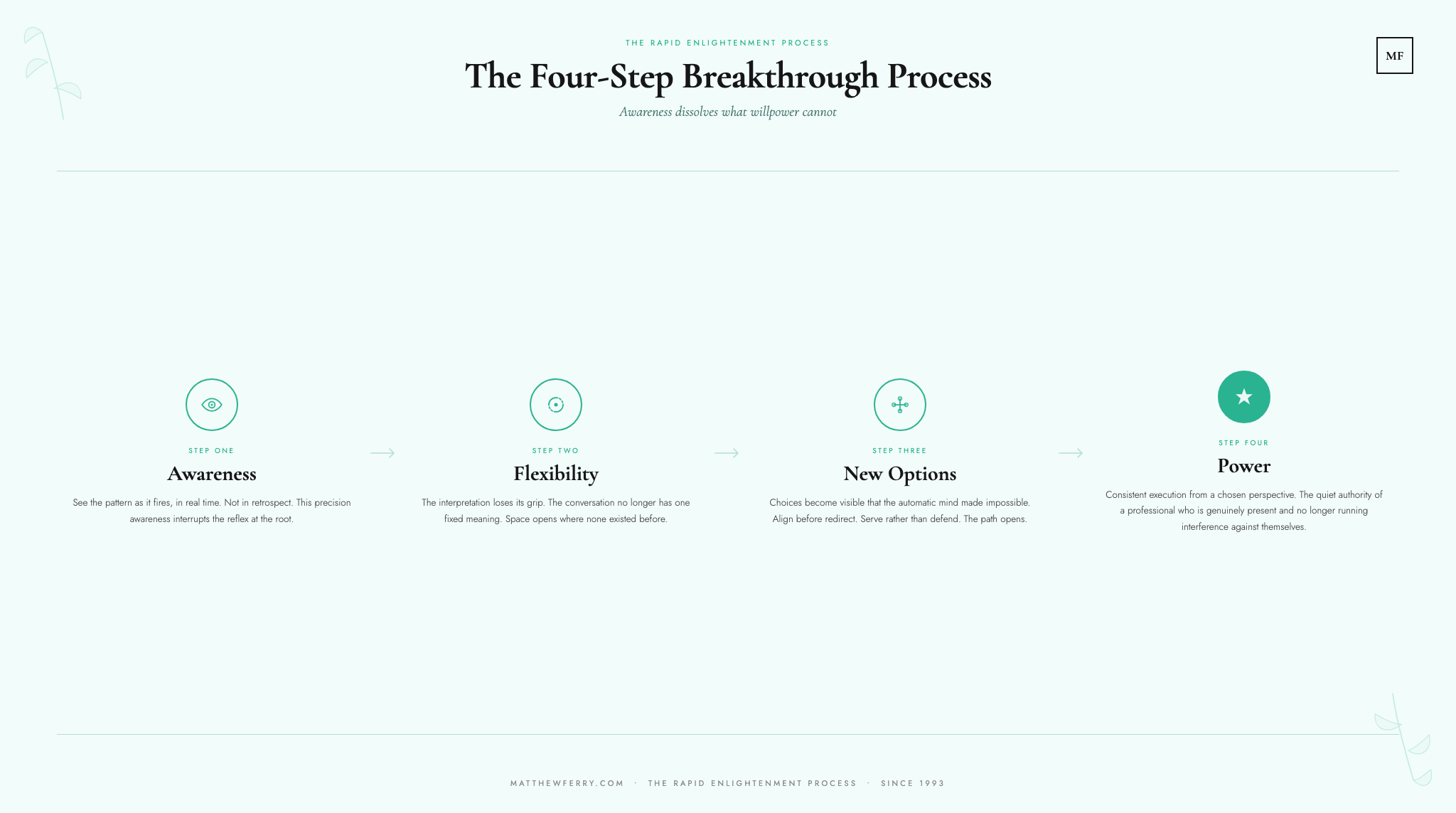
At the functional center of the Rapid Enlightenment Process is a four-step architecture Matthew calls the breakthrough Process. The four steps are: Awareness, Flexibility, New Options, and Power. Understanding each step as a functional shift rather than an abstract ideal makes the methodology concrete and actionable.
Awareness is the first and most critical step. In REP, awareness means seeing The Drunk Monkey’s move as it is happening, in real time, during an actual professional situation. Not in retrospect. Not in analysis after the conversation. In the moment the survival reflex fires. This is precision awareness, not general mindfulness. You are not observing the breath. You are noticing that your survival mind just interpreted a prospect’s objection as a personal attack and is now formulating a defense rather than a response.
Flexibility follows directly from awareness. The moment you see that your interpretation of a situation is an interpretation rather than reality, the interpretation loses its grip. You recognize that the conversation does not have one possible meaning. The prospect’s hesitation is not evidence that you are failing. It is data about their decision-making process. Flexibility is the recognition that the interpretation is not fixed and therefore you are not trapped by it.
New Options appear when flexibility creates space. Before awareness, there was one path: the one The Drunk Monkey chose automatically. After flexibility, there are multiple paths. You can align before redirecting. You can ask a criteria question instead of launching a rebuttal. You can tell a difficult truth from genuine care rather than defend a position from pride. New options are not techniques you memorize. They are possibilities that become visible when the automatic pattern is interrupted.
Power is the outcome of the first three steps operating together. Power, in the REP framework, means consistent execution from a chosen perspective rather than reactive behavior from an automatic one. This is not forceful power. It is the quiet power of a professional who is genuinely present, genuinely committed to the client’s outcome, and no longer running interference against themselves. Perspective determines behavior, and behavior determines results. REP changes perspective at its root, and results follow.
Why “Rapid” Is Not a Marketing Claim
The word rapid in the methodology’s name deserves direct examination because it is easy to misread. Traditional enlightenment protocols described in contemplative literature involve years of dedicated practice, often including periods of profound disorientation as the ego’s structures dissolve. These protocols target something vast: the complete reorganization of the self’s relationship to existence. The timeline is appropriately long because the scope is appropriately enormous.
REP is rapid for a specific reason: it targets a specific, functional interference rather than metaphysical liberation. The Drunk Monkey patterns that sabotage a sales conversation, a leadership decision, or a follow-up call are not infinite and mysterious. They are identifiable. They have names. They follow predictable patterns. They activate in response to recognizable triggers. When the target is this specific, the intervention can be this precise. When the intervention is this precise, the timeline compresses dramatically.
A professional who can name the Hidden Motive firing beneath their avoidance behavior, identify the Unconscious Reflex it has activated, and see the pattern operating in real time has already interrupted the pattern’s automatic authority. That interruption is not a small thing. It is the mechanism by which the gap between knowledge and execution begins to close. Rapidly.
The Drunk Monkey, Hidden Motives, and Why You Keep Stopping Yourself
The conceptual framework and the four-step architecture are clear. Now we choose to look at the actual content of the interference: what The Drunk Monkey is specifically doing when it stops you, what it is protecting, and how REP makes that interference visible and therefore dissolvable.
Meet The Drunk Monkey
Matthew Ferry’s term “The Drunk Monkey” is a compassionate metaphor for the automatic, biological survival mind. The name is important. It is not your enemy. It is not a flaw in your character. It is a survival mechanism running code that was written for an environment of genuine physical danger. It generates continuous mental chatter not because something is wrong with you but because that is what biological survival systems do: they scan for threats, forecast negative outcomes, avoid discomfort, and protect the organism from the unknown.
In the environment The Drunk Monkey was designed for, this was an asset. A mind that forecasted the negative, avoided unfamiliar situations, and responded to social rejection as a threat to survival was a mind that kept its organism alive in genuinely dangerous conditions. The problem is that the survival context has changed and the code has not. In a professional performance context, a rejected follow-up call is not a threat to survival. A prospect who chooses another agent is not evidence of fundamental unworthiness. A pricing conversation that creates tension is not a reason to abandon honest counsel. But The Drunk Monkey does not know this. It responds to these situations with the same urgency it would apply to actual physical threats, and the result is the interference that no technique can override.
REP does not try to defeat The Drunk Monkey or silence it through force of will. It brings the specific pattern into awareness. That awareness is enough. You cannot unsee what you have seen. Once the interference is named, its automatic authority over behavior is interrupted. The professional is then free to choose a response rather than execute a reflex. That choice is where inspired action begins.
The Hidden Motive of Pride and the Unconscious Reflex of Being Right
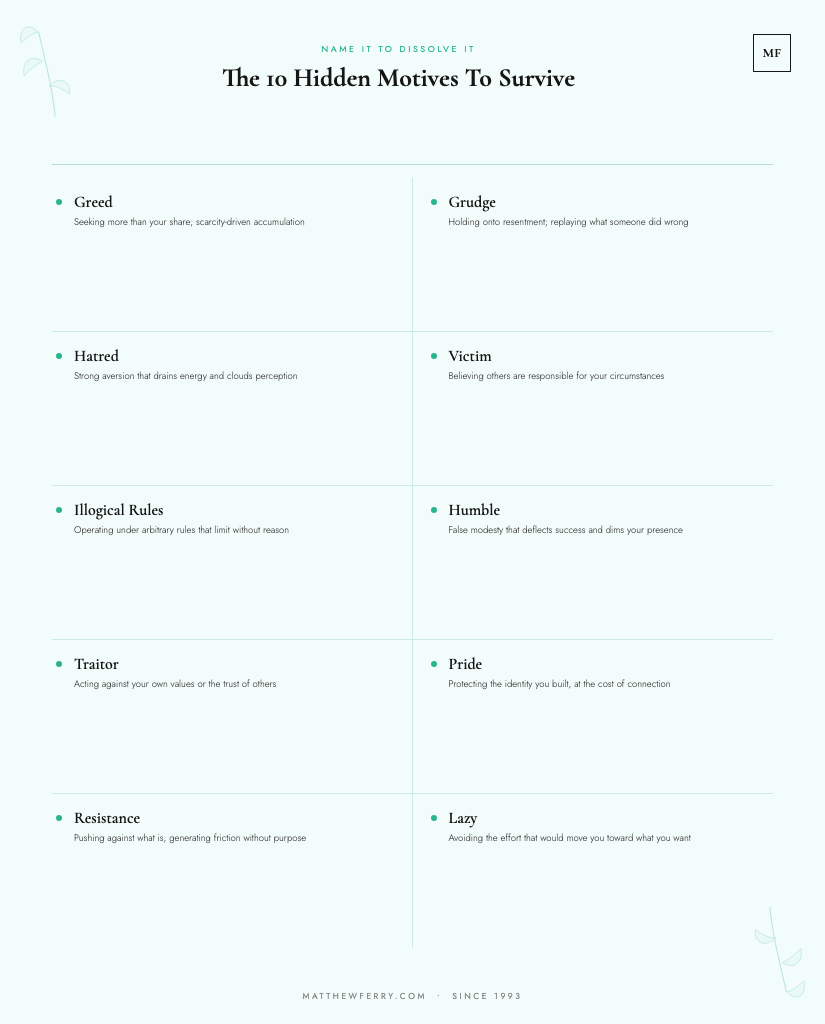
Within the REP framework, Matthew identifies specific categories of survival-mind patterns that produce the most consistent interference in professional performance. These include The Hidden Motives To Survive(tm) and The Unconscious Reflexes(tm). Understanding how a specific Hidden Motive activates a specific Unconscious Reflex is where REP becomes precision work rather than general mindfulness.
The Hidden Motive of Pride is one of the most pervasive and least acknowledged patterns operating in high-performing professionals. Pride, in the REP framework, is not confidence or healthy self-respect. It is The Drunk Monkey’s strategy for protecting the identity you have constructed around being competent, successful, and respected. Every high-performer builds this identity through years of effort, achievement, and peer recognition. The Drunk Monkey then treats that identity as something to be defended at all costs, because threats to status and social standing register in the survival mind as genuine dangers.
Pride activates silently. You will rarely notice it as pride. You will notice it as a sense of irritation when someone questions your expertise. You will feel it as resistance when a prospect’s objection implies you have not explained something clearly. You will experience it as a quiet but firm certainty that you are correct and the other person is simply not understanding what you are telling them. This is the moment Pride has fired and brought with it the Unconscious Reflex of Being Right.
Being Right is one of the named Unconscious Reflexes in the REP framework. It is The Drunk Monkey’s choose to win the internal argument, regardless of whether winning that argument serves any useful purpose. The survival mind does not evaluate Being Right by whether your position is accurate, helpful, or productive. It evaluates Being Right by whether you maintained your position under pressure. This is pure survival logic: in an ancestral social environment, backing down from a position could signal weakness, and weakness had social consequences that threatened survival. The reflex made sense then. In a professional sales or leadership conversation, it is catastrophic.
Here is what Pride activating Being Right looks like in practice. Consider an agent who knows, from training and experience, that the most effective response to a seller’s desire to list above market value is to align with the desire before redirecting toward market reality. The methodology is clear: agree with what the seller wants, demonstrate that you understand why they want it, and then introduce the data that serves their actual goal of selling the home. Align, then redirect. The agent knows this. They have practiced it. They believe in it intellectually.
Then the conversation happens. The seller insists on a price that the agent knows will sit on the market and expire. The agent begins to align, starts to say that they understand why the seller feels that price reflects the home’s value, and then The Drunk Monkey fires. Pride reads the alignment as a concession. Being Right interprets it as weakness. The internal voice says: if you agree with this, you are letting them win. You are the expert here. Why are you capitulating? The agent abandons alignment and pivots to argument. The seller feels unheard, rapport breaks, and the listing goes to a competitor who simply agreed with the price and told the seller what they wanted to hear.
The agent did not lose that listing because they lacked technique. They lost it because Pride activated Being Right at the exact moment alignment would have been most effective. The methodology was available. The Drunk Monkey made it inaccessible.
Now run the same scenario with REP operating. The seller insists on the price. The agent feels the familiar internal pull toward argument. And then, because REP has been practiced, the agent notices it. Not as a vague sense of discomfort but as a specific named pattern: that is Pride. That is Being Right. The Drunk Monkey is reading alignment as defeat and is about to hijack this conversation. The noticing takes a fraction of a second. The pattern is named. Its automatic authority is interrupted. Flexibility enters. The agent chooses alignment because they can see that alignment is not defeat, it is strategy, and the strategy serves the client’s actual goal. The redirect follows naturally. The conversation continues from a position of genuine rapport. The listing is secured.
The difference between these two outcomes is not information or skill. It is the presence or absence of the awareness that REP develops. This is what the methodology does. This is why it is specifically called the Rapid Enlightenment Process: the light of awareness dissolves the interference that kept the professional trapped in a pattern they did not choose and did not want.
Awareness as the Dissolving Agent
It is important to understand that awareness in the REP framework is not passive observation. It is not watching thoughts float by like clouds, which is a useful practice in certain contemplative traditions but is not what REP asks of professionals in high-stakes conversations. REP awareness is active, specific, and immediate. It is the precise act of naming what is happening in the survival mind right now, in this moment, in this interaction.
The mechanism works because of a specific property of automatic patterns: they require invisibility to operate at full authority. When Pride is unnamed, it feels like legitimate certainty. When Being Right is unnamed, it feels like professional conviction. When you cannot see the pattern, you experience it as reality rather than as a reflex. You argue with the seller because it genuinely feels right to argue. You avoid the follow-up call because it genuinely feels like the wrong time. The pattern generates experience, and you respond to the experience as if it were fact.
The moment you name the pattern, the experience shifts. Pride is now a named survival reflex, not a legitimate signal about the professional situation. Being Right is now an identified Drunk Monkey move, not an accurate read of the conversation. The experience does not necessarily disappear immediately. But its authority over your behavior does. You can see that you are watching a survival mechanism operate. You are not the mechanism. You have the option to choose differently.
You do not choose to understand the complete psychological history of why Pride developed in your particular case. You do not choose to trace it to childhood experiences or social conditioning, though that work has its own value. For REP’s purposes in professional performance, you choose to see it operating right now, in this conversation. That seeing is sufficient. Awareness is the dissolving agent. Everything else in the methodology flows from that moment of recognition.
This is also why REP does not require years of retreat practice to produce functional results. The leverage point is specific and the intervention is precise. Named patterns lose automatic authority. Unnamed patterns retain it. REP names them. The process can begin producing results in the first conversation where you notice the Hidden Motive and the Unconscious Reflex operating beneath your resistance.
How the Process Works in Practice
The philosophy is coherent. The mechanism is clear. The question that remains is practical: what does REP actually look like as a daily process for a professional who is not in a monastery but in a business that requires consistent execution?
Perspective as the Causal Layer
A principle central to REP’s practical application is this: perspective is the causal layer beneath behavior. You do not change results by directly targeting results. You change results by changing the perspective from which you engage with the activities that produce them. Behavior flows from perspective with a reliability that technique cannot manufacture.
Consider two professionals performing the same follow-up call. The first professional interprets follow-up as chasing someone who has already shown limited interest, which registers in The Drunk Monkey as potential rejection and triggers Avoiding Embarrassment, one of the named Unconscious Reflexes. The call is made reluctantly, with lowered energy, minimal persistence, and an internal bias toward ending the conversation quickly if any friction appears. The second professional interprets follow-up as continuing to serve someone who has not yet found the solution they need, which registers as service rather than risk. The call is made with genuine curiosity, appropriate persistence, and an internal orientation toward the prospect’s outcome rather than the professional’s comfort. Same action. Dramatically different execution and results.
REP changes the perspective, not the action. When the perspective shifts from chasing to serving, the action changes without requiring willpower. The call becomes something you want to make because your operating interpretation is one of genuine care rather than survival risk. This is the practical meaning of Enlightened Perspectives(tm): perspectives that produce consistent, effective, service-oriented execution without requiring constant effort to overcome internal resistance.
The Unconscious Reflexes and How REP Exposes Them
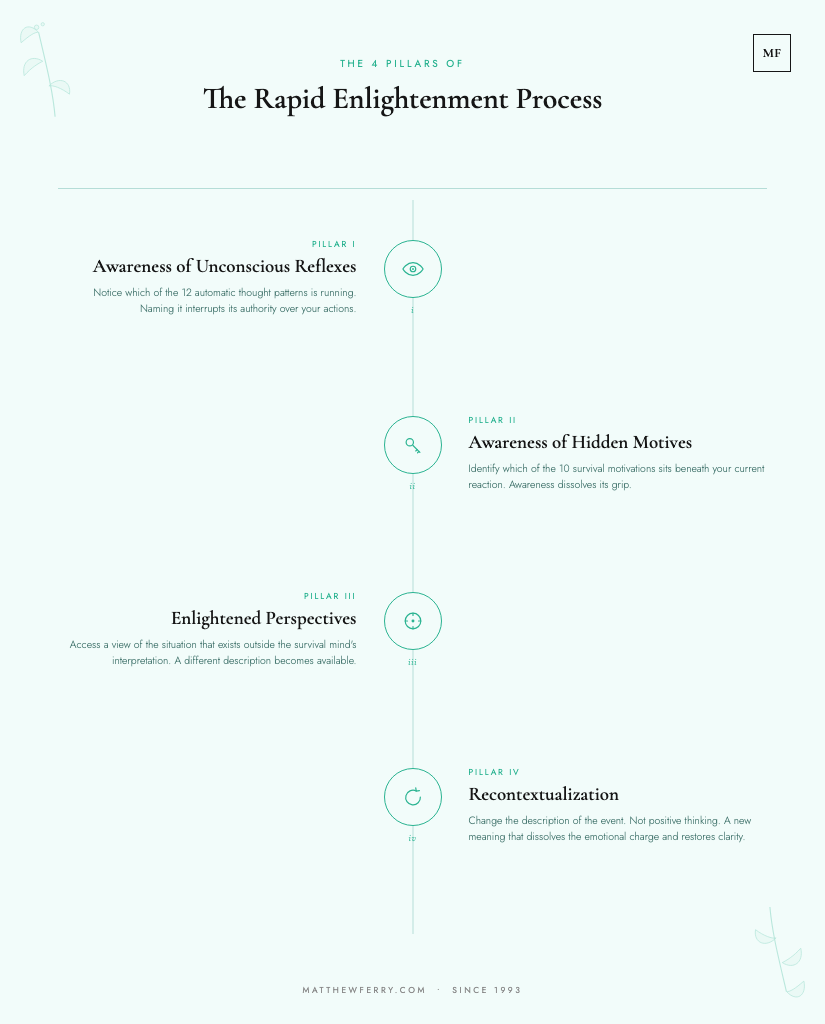
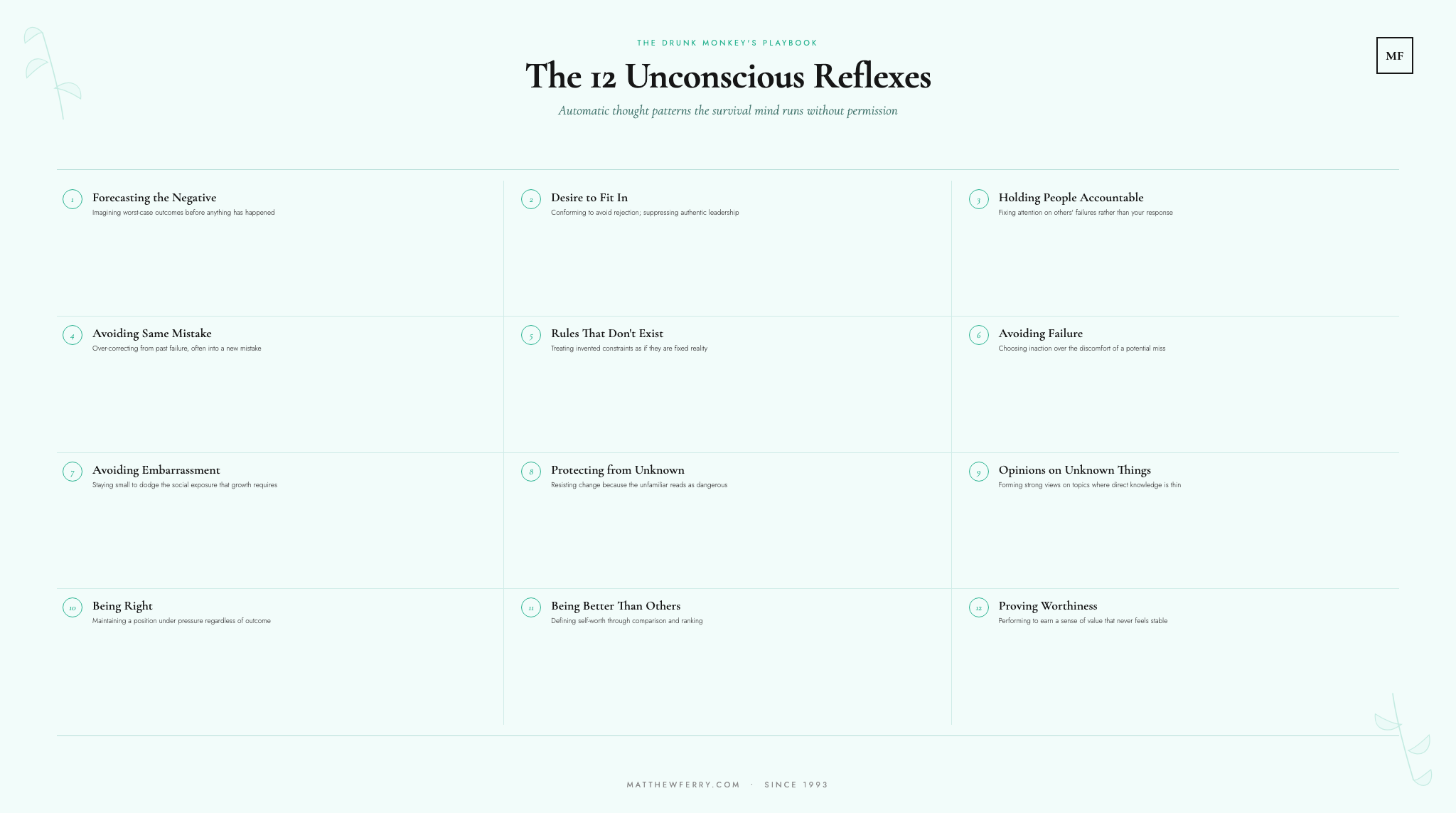
The REP framework includes a structured vocabulary for the specific automatic patterns The Drunk Monkey deploys most frequently. These Unconscious Reflexes include: Forecasting the Negative, Desire to Fit In, Holding People Accountable, Avoiding the Same Mistake Twice, Following Rules That Don’t Exist, Avoiding Failure, Avoiding Embarrassment, Protecting from the Unknown, Opinions on Things You Know Nothing About, Being Right, Being Better Than Others, and Proving Worthiness.
Each of these reflexes has a recognizable signature in professional performance contexts. Forecasting the Negative creates the internal experience of certainty that the call will go poorly, the prospect will reject the proposal, or the market will turn before the deal closes. Avoiding Failure prevents bold recommendations because making a strong recommendation creates the possibility of being visibly wrong. Avoiding Embarrassment produces the hesitation before a difficult conversation, the instinct to soften a truth until it no longer serves the client, and the avoidance of follow-up after a conversation that created friction.
REP does not ask you to eliminate these reflexes. It asks you to name them. The naming is the intervention. When you can say, in the moment of resistance, that is Avoiding Failure, or that is Forecasting the Negative, you have separated yourself from the reflex. You are no longer the reflex. You are the awareness noticing the reflex. From that position, the breakthrough Process can operate: Awareness has occurred, Flexibility becomes available, New Options appear, Power follows.
The REP framework also pairs these reflexes with Hidden Motives because the motives are often what activate the reflexes. Resistance, one of the named Hidden Motives, activates Forecasting the Negative because resistance generates narratives of why action is unlikely to succeed. Victim, another named Hidden Motive, activates Holding People Accountable because the victim posture requires others to be responsible for the situation. Lazy, as a Hidden Motive, activates Following Rules That Don’t Exist because invented rules create justifications for inaction. Seeing the motive and the reflex together provides a more complete picture of the interference pattern, which makes the awareness sharper and therefore more dissolving.
The 90-Day Implementation Architecture
REP is not a one-time insight. A single moment of awareness, as powerful as it is, does not permanently reconfigure years of survival programming. The methodology is a conditioning process. Awareness can be practiced until the new perspective becomes the default operating posture. This is why Matthew’s curriculum includes a 90-day implementation architecture built around five specific practices: reminders, repetition, exposure, questioning assumptions, and observing The Drunk Monkey in daily professional life.
Reminders are physical, environmental, or scheduled prompts that bring the REP framework back into conscious attention during the workday. A note on the monitor. A phrase at the top of the call list. A brief review of the named reflexes before a high-stakes meeting. These reminders interrupt the automatic mind’s tendency to slip back into default survival patterns between conscious practice sessions.
Repetition is the conditioning mechanism. The first time you name Pride and Being Right in a conversation, the naming feels effortful and slightly awkward. The tenth time, it is faster. The fiftieth time, it has become a reflex of its own, a learned automatic response to the interference rather than unconscious submission to it. Repetition is not about drilling technique. It is about making awareness habitual.
Exposure means deliberately placing yourself in situations where The Drunk Monkey is likely to activate, not to create suffering, but to practice awareness in conditions where the interference is real rather than theoretical. The follow-up call you have been avoiding is not just a business activity. It is a REP practice opportunity. The pricing conversation you have been softening is not just a challenge to navigate. It is a chance to notice which Hidden Motive is causing the softening and name it before it runs the conversation.
Questioning assumptions is the intellectual practice of REP. Before a significant conversation, pause and identify what interpretations The Drunk Monkey has already assigned to it. Is this follow-up call already coded as an interruption in someone else’s day? Is this listing appointment already coded as a competition you might lose? Are those interpretations reality, or are they survival reflexes generating experience that feels like reality? Questioning them does not mean pretending to certainty you do not have. It means noticing that the interpretation is not fixed and therefore is not required.
Observing The Drunk Monkey in daily professional life is the ongoing practice that ties all of the above together. Throughout the day, across all interactions, the practice is simply to notice. Notice when Forecasting the Negative colors a call before it is made. Notice when Pride stiffens a response that would benefit from flexibility. Notice when Avoiding Embarrassment softens a truth the client genuinely needs. The noticing is enough. It does not require analysis or correction. Awareness dissolves the pattern. Your only job is to see it.
What Changes When the Survival Mind Dissolves
Descriptions of methodology are useful. Descriptions of outcome are essential. If REP is working, what does professional life actually look like? What changes in the conversations, the decisions, the daily experience of doing work that matters?
Prosperity as the Destination
Matthew Ferry describes the destination of REP as Enlightened Prosperity(tm): success without stress. This phrase deserves careful unpacking because it is easy to misread. It does not mean the absence of challenge, difficulty, or complexity. Real professional life involves all of these. It does not mean a permanent state of contentment that protects you from the ordinary friction of ambitious work. It means the absence of The Drunk Monkey’s interpretation of those challenges as existential threats.
When a pricing conversation is difficult, Enlightened Prosperity does not make it effortless. It makes it clean. You are present with the difficulty rather than also caught in the survival mind’s catastrophic projections about what the difficulty means about your competence, your worth, and your future. The conversation can be what it actually is, a complex professional situation requiring honesty, skill, and genuine care, rather than also being a battlefield where your survival identity is at stake. There is peace in that clarity.
Professionals who have worked REP consistently describe a shift from reactive to creative. Problems that previously triggered defensive responses now generate curiosity. Objections that previously activated Pride and Being Right now activate genuine interest in understanding the prospect’s perspective. Follow-up that previously felt like chasing now feels like serving. These are not attitude adjustments imposed by willpower. They are the natural result of removing the interference that was producing the previous experience. When the Drunk Monkey’s automatic authority is interrupted consistently, the authentic self, which is genuinely curious, genuinely service-oriented, and genuinely creative, becomes the default operating presence.
Performance Outcomes That Become Possible
The performance implications of Enlightened Prosperity are specific and observable. When Pride and Being Right no longer run high-stakes conversations, the Align and Redirect approach becomes natural rather than effortful. A professional who is not defending an identity does not choose to win arguments. They can genuinely agree with a prospect’s perspective as a first move, because agreement is not a concession, it is a bridge. Rapport builds instead of breaks. The redirect that follows is received as counsel from an ally rather than pressure from a salesperson.
When Forecasting the Negative no longer poisons the follow-up call before it is made, consistent prospecting becomes sustainable. The call that the survival mind coded as likely to produce rejection is approached with genuine neutrality. It might go well. It might not. Either way, it is data, not disaster. The Real Estate Scientist approach, which Matthew describes as gathering data, measuring outcomes, tracking follow-up, and continuously refining the process, becomes possible only when The Drunk Monkey’s catastrophic interpretations are dissolved. You cannot run an experiment if the survival mind has already decided the result.
When Avoiding Failure no longer controls decision-making, bold service becomes the default. The client who needs to hear a difficult truth about pricing, timing, or market reality receives that truth from a professional whose survival mind is not scanning for the social cost of delivering it. Truthful counsel delivered from genuine care creates trust at a depth that comfortable agreement never reaches. Clients who receive truth from an advocate they trust become clients who refer, return, and remain. The long-term business consequences of dissolving Avoiding Failure are not subtle.
The consistent pattern across all of these outcomes is the same: the dissolution of a specific Drunk Monkey interference pattern, not the acquisition of a new technique, produces the performance change. Agents who handle objections from Complete Detachment, Advocate Mentality, and Truth Over Comfort consistently outperform agents with superior scripts but inferior mindset. The scripts are available to everyone. The mindset that makes the scripts work requires REP.
Mental Stillness as the Professional Edge
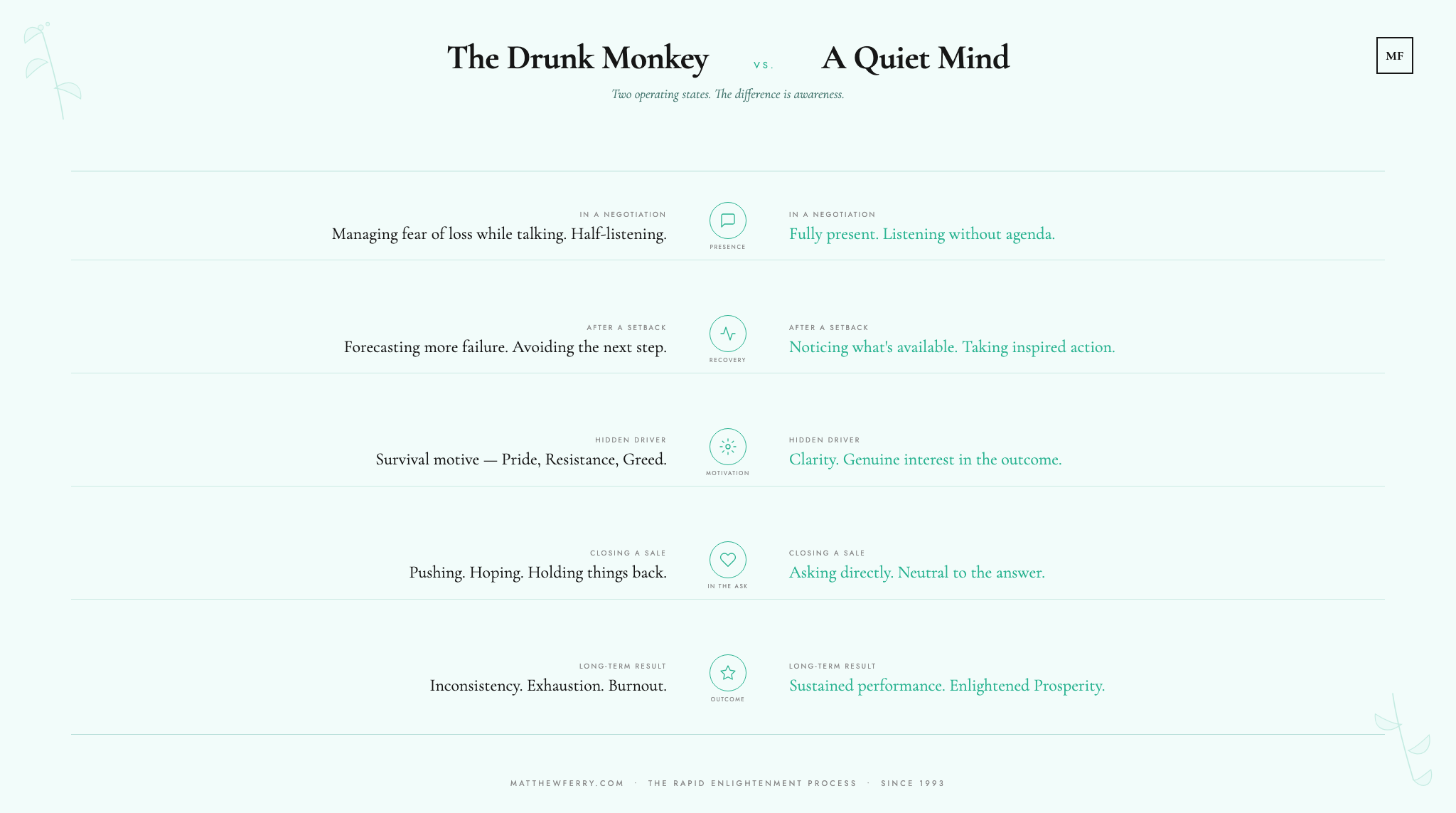
Matthew’s book Quiet Mind Epic Life names the outcome state with precision. A Quiet Mind(tm) is not a passive mind. It is not an empty mind. It is not a mind that has stopped engaging with complex, demanding professional situations. It is a mind that is no longer hijacked by survival reflexes in situations that do not actually threaten survival. The distinction is everything.
A quiet mind in a high-stakes negotiation is present with the negotiation, not also caught in the survival mind’s commentary about what losing the deal would mean about the professional’s worth and future. A quiet mind in a difficult client conversation is genuinely listening rather than composing rebuttals while the client speaks. A quiet mind making a bold recommendation is offering counsel from clarity rather than from anxiety about being wrong.
This is the professional edge that REP creates. Not superior information. Not better scripts. Not more confidence manufactured through affirmations. A mind that is actually quiet enough to perceive what is happening in front of it clearly, respond from chosen intention rather than automatic reflex, and remain present with the complexity of real professional situations without adding the Drunk Monkey’s catastrophic interpretation to every moment of friction.
In competitive professional environments, where technique is increasingly commoditized and information is universally available, the quiet mind is a genuine differentiator. Clients feel the difference between a professional who is present and one who is caught in internal noise while pretending to listen. Prospects trust the difference between advice given from genuine care and advice given from a mind calculating its own survival implications. REP produces the former. The professional edge it creates is not marginal.
Who This Method Is For, and How to Begin

The Rapid Enlightenment Process is a specific methodology, not a universal program. It serves a specific profile of professional. Understanding that profile helps you assess honestly whether REP addresses your actual situation and what the right starting point within Matthew’s ecosystem is for you.
The Profile of Someone Ready for REP
REP is for high-conscious go-getters. The term matters. It describes professionals who are already operating with awareness that their internal state affects their performance, who already have a business model and the technical knowledge to execute it, and who are already producing real results. The gap they experience is not a gap in knowledge or technique. It is a persistent gap between what they know and what they consistently do.
If you find yourself knowing the follow-up needs to happen and not making the call, knowing the truth needs to be delivered and softening it until it loses its value, knowing the alignment approach works and abandoning it under pressure, REP is likely addressing your actual obstacle. The Drunk Monkey is not a problem that more information solves. It is a problem that awareness dissolves.
REP requires a specific kind of willingness: the willingness to look honestly at the automatic patterns operating in your professional behavior without immediately defending them as legitimate and rational. Pride is particularly skilled at convincing you that your defensive responses are principled positions. Being Right is particularly skilled at generating the experience of certainty that your resistance is justified. REP asks you to hold that certainty lightly enough to question it. Not to abandon conviction, but to distinguish between professional judgment and survival reflex. This willingness is not common. Among those who have it, REP produces results with a consistency that other approaches do not match.
Matthew Ferry has served thousands of professionals in direct sales, network marketing, real estate, and finance since 1993. He has delivered two TEDx talks and authored six books, including Quiet Mind Epic Life. He is the Creator of the Mental Journey to Millions and serves as the Lead Instructor of SUCCESS Coaching Certification. The depth and breadth of this experience means REP has been refined through contact with real performance challenges in real professional environments, not developed in theoretical isolation.
Starting Points Within the Matthew Ferry Ecosystem
The Matthew Ferry International library offers several entry points into REP, depending on your professional context and your current position in the learning journey.
The Mental Journey to Millions extends REP into the domains of wealth, identity, consciousness, and the deeper architecture of the Enlightened Prosperity outcome state. Quiet Mind Epic Life is Matthew’s book that describes the outcome state and the philosophy underlying all of these programs. Either is a legitimate starting point depending on where you currently experience the most interference.
The One Practice That Begins Everything
Today, in one conversation where you feel resistance, do one thing. Name the Hidden Motive and the Unconscious Reflex operating beneath it. You do not choose to fix anything. You do not choose to argue with the pattern or overcome it through effort. You do not choose to pretend it is not there. Simply name it. That is Pride. That is Being Right. Or: that is Resistance. That is Forecasting the Negative. Or: that is Victim. That is Holding People Accountable.
Name it and then notice what happens to its authority over your next response. Notice whether the naming creates even a fraction of a second of space between the reflex and the behavior. Notice whether that space allows a different option to become visible. You do not choose to take that option immediately. You only choose to notice that it exists.
That noticing is Awareness. Awareness is where Flexibility begins. Flexibility is where New Options appear. New Options are where Power lives. And Power, in the REP framework, is the quiet capacity to execute from chosen intention rather than automatic reflex in a professional situation that genuinely matters to you and to the people you serve.
That is where REP starts working. Not in a retreat, not in an extended study program, not after years of preparation. In the next conversation where you feel resistance and choose to name what is happening instead of following it blindly. The process begins exactly there. It has been beginning there, for thousands of professionals, since 1993.
Closing
The Rapid Enlightenment Process is not a philosophy to study. It is a process to practice. The gap between your knowledge and your execution is not a character flaw. It is The Drunk Monkey doing exactly what it was designed to do: protect you from perceived threats in an environment where the real obstacle is your own reactivity. Since 1993, Matthew Ferry has worked with thousands of professionals to close that gap, not by adding more information, but by dissolving the interference that prevents the information they already have from producing results.
The process is rapid because the target is specific and the intervention is precise. When you can name Pride and Being Right in the moment they fire, the pattern loses its automatic authority. When you can see Forecasting the Negative coloring a call before it is made, you can choose a different interpretation. When Avoiding Failure no longer controls your recommendations, your clients receive the truth they need from a professional who genuinely cares about their outcome rather than their own comfort.
The outcome, Enlightened Prosperity, success without stress, is not a distant ideal reserved for people with more time, more spiritual inclination, or more patience for long practices. It is available the moment The Drunk Monkey’s automatic authority is interrupted by clear, honest awareness. That moment can happen in the next conversation. The Rapid Enlightenment Process is how you make it happen on purpose, repeatedly, until the quiet mind becomes your professional default rather than a rare and welcome exception.
Frequently Asked Questions
What is the Rapid Enlightenment Process in simple terms?
The Rapid Enlightenment Process is a structured methodology developed by Matthew Ferry for identifying and dissolving the automatic survival-mind patterns that prevent professionals from consistently executing what they already know. It is built on the breakthrough Process: Awareness, Flexibility, New Options, and Power. The target is The Drunk Monkey, Matthew’s compassionate term for the biological survival mind that produces fear, procrastination, and emotional reactivity in professional situations. REP was peer-reviewed and published in the Journal of Advanced Research in Social Sciences in 2023.
Is the Rapid Enlightenment Process related to spiritual enlightenment?
The relationship is conceptual rather than identical. Both traditional enlightenment approaches and REP are fundamentally about dissolving interference rather than acquiring new information. Ancient Buddhist traditions, both gradual and sudden, describe the obstacle to awakening as obscuration, not ignorance of content. REP applies this same principle to professional performance: the obstacle to consistent execution is the automatic survival mind’s interference, not a lack of technique. REP is functional and professional in its focus, not metaphysical or religious, but it draws on the same core insight that awareness dissolves obstruction.
How is REP different from other mindset or self-help approaches?
Most mindset approaches attempt to build positive mental states on top of existing survival patterns through affirmations, visualization, or motivational conditioning. REP targets the survival patterns directly by making them visible. The distinction is structural: you cannot build a stable productive mindset on top of an unnamed Drunk Monkey. REP dissolves the interference rather than covering it. Additionally, REP provides a structured vocabulary for naming specific patterns (Hidden Motives and Unconscious Reflexes) rather than working with vague notions of negative thinking, which makes the intervention precise and immediately applicable in professional situations.
What are The Hidden Motives To Survive and The Unconscious Reflexes?
The Hidden Motives To Survive are the specific survival-oriented drives The Drunk Monkey uses to generate interference in professional behavior. Named motives include Pride, Greed, Grudge, Hatred, Victim, Illogical Rules, Humble, Traitor, Resistance, and Lazy. The Unconscious Reflexes are the specific automatic behavioral patterns these motives activate, including Being Right, Forecasting the Negative, Avoiding Failure, Avoiding Embarrassment, Holding People Accountable, and others. REP teaches professionals to recognize how a specific Hidden Motive activates a specific Unconscious Reflex in real professional situations, which makes the awareness precise enough to interrupt the pattern before it controls behavior.
Why does naming a pattern dissolve its authority rather than just labeling it?
Automatic patterns require invisibility to operate at full authority. When Pride is unnamed, it registers as professional certainty. When Being Right is unnamed, it feels like rational conviction. The pattern generates experience, and you respond to the experience as if it were an accurate read of external reality. The moment you name the pattern, you separate yourself from it. You are now the awareness noticing the reflex rather than being the reflex. This separation does not require analysis, processing, or time. It is immediate. From that separation, the breakthrough Process operates: Awareness creates Flexibility, Flexibility reveals New Options, New Options produce Power.
How long does it take for REP to produce results?
The first results, the experience of a fraction of space between the reflex and the response, can appear in the first conversation where you successfully name the Hidden Motive and the Unconscious Reflex operating beneath your resistance. Sustainable results, where the new perspective becomes the default operating posture rather than a conscious effort, typically require the 90-day implementation architecture: consistent practice of reminders, repetition, exposure, questioning assumptions, and daily observation of The Drunk Monkey. REP is rapid relative to traditional enlightenment protocols because the target is specific and functional rather than metaphysical, but it is still a conditioning process that requires practice to produce lasting change.
Who is the Rapid Enlightenment Process designed for?
REP is designed for high-conscious go-getters: professionals who already have a business model, already possess the technical knowledge to execute it, and are already producing real results, but who experience a persistent gap between what they know and what they consistently do. It is particularly effective for professionals in direct sales, network marketing, real estate, entrepreneurship, and finance, where the high-stakes conversations that most activate The Drunk Monkey are also the conversations that most directly determine results. It requires honest willingness to examine automatic patterns without immediately defending them as rational. Matthew Ferry has served thousands of professionals in this profile since 1993.
Where do I start with the Rapid Enlightenment Process in Matthew Ferry’s programs?
The entry point depends on your professional context and where you currently experience the most interference. The Mental Journey to Millions extends REP into the deeper architecture of consciousness, wealth, and identity. Quiet Mind Epic Life is Matthew’s book that describes the outcome state and the philosophy underlying all of his programs. Either is a strong starting point for professionals ready to close the gap between what they know and what they consistently do.

